Wednesday, June 18, 2014

Iggy Pop: Blowtorch in Bondage


By Lester Bangs from Psychotic Reactions and Carburetor Dung

Iggy Pop: Blowtorch in Bondage

By any normal standards, Iggy pop’s gig at the Palladium last Friday night was a triumph. Iggy himself was in ferociously fine form, and the crowd was ravenously enthusiastic-he could have had as many encores as he wanted.  But normal standards have never seemed relevant to Iggy—from the earliest days, when The Stooges went onstage not even knowing how to play their instruments, to the present, when he finally seems to be on the verge of becoming one of the strangest stars we’ve ever seen.  What kind of person tries, for his third and crucial attempt, to make it big-time rock ’n’ roll with an album called The Idiot?  The kind, I suppose, who at one time regularly made a practice of literally diving headfirst from the lip of the stage into the middle of his audience and who on Friday night repeatedly twisted his face and body up into masks and gestures symbolic of “idiocy,” torment, and, most of all, bondage.

More than anyone else in the seemingly endless parade of professionally anomic rockers, Iggy really is isolated, and this isolation manifests itself in lightning-stricken desperation.  He’s the most intense performer I’ve ever seen, and that intensity comes from a murderous drivenness that has in the past also made him the most dangerous performer alive: the plunges into the third row, cutting himself and rolling in broken glass onstage, getting into verbal and occasionally physical brawls with his audiences.  When Iggy sang, “I’m losing all my feelings / And I’m runnin’ out of friends” in “I Need Somebody” on Raw Power, he was describing, succinctly, as usual, the problem, the anomie.  That there is no solution but death is why all the rest of it happens.  This is a person who feels profoundly unalive, or, conversely, so rawly alive, and so imprisoned by it, that all feeling is perceived as pain.  But feeling is still courted, in the most apocalyptic terms, which are really the only terms the performer can even understand, and the performance begins to look more and more like a seizure every time he hurls himself across the stage.

It’s not minimizing all this to say that what it means for Iggy is ambivalence.  “I’m dying in a story / I’m only living to sing this song,” another line from “I Need Somebody,” conveys the powerful ambivalence he feels toward his audience, his art itself.  An apocalypse isn’t supposed to be manageable, and when the carnage is done it ain’t the audience that’s gonna be bleeding.  But manage the apocalypse is exactly what Iggy is now trying to do, because this idiot is no fool, and he knows the lie of a manageable Armageddon is the only way to make it in the rock ‘n’ roll end of showbiz and survive.  That’s why David Bowie is twerping around, trimming the dementia here and there with neat little clips, and that’s why The Idiot, Iggy’s new album (produced and influenced in every respect by Bowie, who also plays piano in Iggy’s current touring band), rings to false.

A far more powerful documentation of the Iggy holocaust at its most nihilistically out of control is available on Metallic K.O., a bootleg import (on Skydog) of the last concert the Stooges ever played, at the Michigan Palace in Detroit January of 1974.  I was at the gig immediately preceding it, at a little club in Warren, Michigan, two nights before, where the love-hate affair the Stooges had been carrying on with their audience for so long finally careened to its inevitable consequences.  The audience, which consisted largely of bikers, was unusually hostile, and Iggy, as usual, fed on that hostility, soaked it up and gave it back and absorbed it all over again in an eerie, frightening symbiosis.  “All right,” he finally said, stopping a song in the middle, “you assholes wanta hear ‘Louie Louie,’ we’ll give you “Louie Louie,” including new lyrics improvised by the Pop on the spot consisting of “You can suck my ass / You biker faggot sissies,” etc.

By now the hatred in the room is one huge livid wave, and Iggy singles out one heckler who has been particularly abusive: “Listen, asshole, you heckle one more time and I’m gonna come down there and kick your ass.”  “Fuck you, you little punk,” responds the biker.  So Iggy jumps off the stage, runs through the middle of the crowd, and the guy beats the shit out of him, ending the evening’s musical festivities by sending the lead singer back to the motel room and a doctor.  I walk into the dressing room, where I encounter the manager of the club offering to punch out anybody in the band who will take him on.  The next day the bike gang, who call themselves the Scorpions, will phone WABX-FM and promise to kill Iggy and the Stooges if they play the Michigan Palace on Thursday night.  They do (play, that is), and nobody gets killed, but Metallic K.O. is the only rock album I know where you can actually hear hurled beer bottles breaking against guitar strings.

On one level I suppose all of this is very funny, but if you look past the surface violence and simple abusiveness to the person at the center it’s not funny at all.  The reason it’s not is the aforementioned ambivalence.  Jungle war with bike gangs is one thing, but it gets a little more complicated when those of us who love being around that war (at least vicariously) have to stop to consider why and what we’re loving.  Because one of the things we’re loving is self-hate, and another may well be a human being committing suicide.  Here’s a quote from a review of Iggy’s new live show in the British rock weekly Sounds: “Iggy’s a dancer and more, a hyper-active packet of muscle and sinew straight out of Michelangelo’s wet dreams …who leaps and claws at the air, audience and mike stand in an unsurpassable display that spells one thing—MEAT.”  Ignoring the florid prose, I’d like to ask the guy who wrote that how he would like to be thought of as a piece of meat, how he thinks the meat feels.  Or if he thinks it feels at all.  Yeah, Iggy’s got a fantastic body; it’s so fantastic he’s crying in every nerve to explode out of it into some unimaginable freedom.  It’s as if someone writhing in torment has made that writhing into a kind of poetry, and we watch in awe of such beautiful writhing, so impressed that we perhaps forget what inspired it in the first place.

As for the performer himself, he carries that hurt like spikes in his heart, but there is simultaneously a strong element of unconsciousness in his art, which is one of the main reasons why it’s so beautiful and so intense.  During Iggy’s second encore Friday night, as he sang a song called “China Girl” with a stagehand holding a light under him for dramatic Fu Manchu effect, he pulled his face taut with his hands to make slits of his eyes and began to hop in a bizarre imitation of some bound coolie.  It was at once grotesque and lovely, conveying in a few simple gestures a pathos so immense that I’m sure if Iggy himself could have seen what he looked like at that moment he would have been mortified.  Because there was a vulnerability so naked it wrenched the heart.  At that moment I realized that this man did not know what he was doing, and maybe precisely because of that it was one of the most alive things I’ve ever witnessed, just as the performance on Metallic K.O. is a wrigglingly, obscenely alive, and the person singing on The Idiot sounds like a dead man.  Iggy may finally become the superstar we always knew he could be, and he’s already transcended the punk-rock he almost singlehandedly birthed, but there are questions unanswered, and a life hanging on the answers, and I’m not even sure that those answers exist.

Village Voice, 28 March 1977

Three sweet Lester Bangs books

Bangs, Lester, and Greil Marcus. Psychotic Reactions and Carburetor Dung. New York: Anchor, 2003. Print

Bangs, Lester, and John Morthland. Mainlines, Blood Feasts, and Bad Taste: A Lester Bangs Reader. New York: Anchor, 2003. Print.

DeRogatis, Jim. Let It Blurt: The Life and times of Lester Bangs, America's Greatest Rock Critic. New York: Broadway, 2000. Print.


Thursday, May 29, 2014

Carl Jung The Red Book


From 1913 to 1930 Carl Jung engaged in an experiment that he referred to as a confrontation with his unconscious.  In this book Jung recorded employed the method he called active imagination.  According to Sonu Shamdasani’s introduction in Liber Novus (The Red Book), “He called this experiment or exercise of emptying his consciousness as his most difficult experiment.  His boring method of introspection uses trance states that mediums used where the fantasy world and hallucinatory states are real used with automatic writing” (200).  Jung discovered the technique of active imagination while studying the veracity of psychic mediums.  He used active imagination to record his thoughts and visions while also painting the images and mandalas that came to him.  Shamdasani writes, “The making of Liber Novus was by no means a peculiar and idiosyncratic activity, nor the product of psychosis.  Rather, it indicates the close intersection between psychological and artistic experimentation with which many individuals were engaged at the time” (204).  Liber Novus was evidence of Jung’s emerging technique of psychotherapy enabling the individual to develop through the process of individuation.  Liber Novus is the result of these experiments, a notorious book that has been known about for years but has not been published until recently in 2008.  


Check out this episode!

Images and Passages from Liber Novus


Here are some selected quotes and images from Liber Novus along with a link to the New York Times article by Sara Corbett.


Here are a few selected quotes from Liber Novus

“To the extent that the Christianity of this time lacks madness, it lacks divine life.  Take note of what the ancients taught us in images: madness is divine.  But because the ancients lived this image concretely in events, it became a deception for us, since we became masters of the reality of the world.” (238)

Life does not come from events, but from us.  Everything that happens outside has already been.”  (239)

I would not have been able to see what was to come if I could not have seen it myself. 
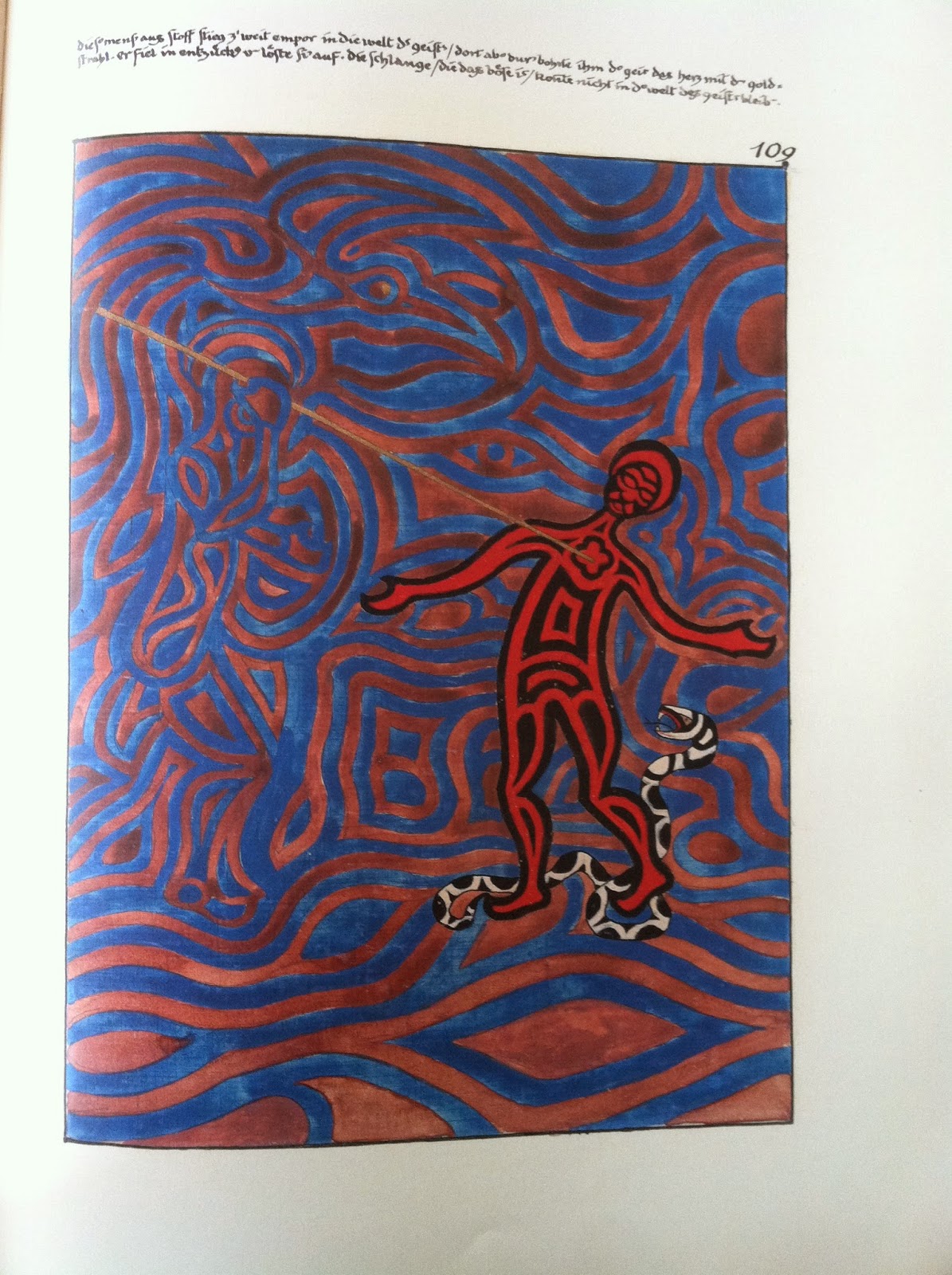
            Therefore I take part in that murder; the sun of the depths also shines in me after the murder has been accomplished; the thousand serpents that want to devour the sun are also in me.  I myself am a murderer and murdered, sacrifice and sacrificed.  The upwelling blood streams out of me.  You all have a share in the murder.  In you the reborn one will come to be, and the sun of the depths will rise, and a thousand serpents will develop from your dead matter and fall on the sun to choke it.  Your blood will stream forth.  The peoples unforgettable acts, that will be written with blood in unforgettable books for eternal memory.  (239)

It is unquestionable: if you enter into the world of the soul, you are like a madman, and a doctor would consider you to be sick.  What I say here can be seen as sickness, but no one can see it as sickness more than I do. 
            This is how I overcame madness.  If you do not know what divine madness is, suspend judgement and wait for the fruits.  But know that there is a divine madness which is nothing other than the overpowering of the spirit of this time through the spirit of the depths.  Speak then of sick delusion when the spirit of the depths can no longer stay down and forces a man to speak in tongues instead of in human speech, and makes him believe that he himself is the spirit of the depths.  (238)

But during the 25 days, I gave all my love and submission to things, to men, and to the thoughts of this time.  I went into the desert only at night.  (238)

Blood shone at me from the red light of the crystals and when I picked up to discover its mystery, there lay the horror uncovered before me: in the depths of what is to come lay murder.  The blond hero lay slain.  The black beetle is the death that is necessary for renewal; and so thereafter, a new sun glowed, the sun of the depths, full of riddles, a sun of the night.  And as the rising sun of spring quickens the dead earth, so the sun of the depths quickened the dead, and thus began the terrible struggle between light and darkness.  Out of that burst the powerful and ever unvanquished source of blood.  This is what was to come, which you now experience in your life, and it is even more than that.  (I had this vision on the night of 12 December 1913).  (239)

As the fate of the peoples is represented to you in events, so will it happen in your heart.  If the hero in you is slain, then the sun of the depths rises in you, glowing from afar, and from a dreadful place.  But all the same, everything up till now seemed to be dead in you will come to life, and will change into poisonous serpents that will cover the sun, and you will fall into night and confusion.  Your blood also will stream from many wounds in this frightful struggle.  Your shock and doubt will be great, but from such torment the new life will be born.  Birth is blood and torment.  Your darkness, which you did not suspect since it was dead, will come to life and you will feel the crush of total evil and the conflicts of life that still now lie buried in the matter of your body.  But the serpents are dreadful evil thoughts and feelings.  (239)

If the God grows old, he becomes shadow, nonsense, and he goes down.  The greatest truth becomes the greatest lie, the brightest day becomes darkest night.
            So the reality is meaning and absurdity.  Noon is a moment, midnight is a moment, morning comes from night, evening turns into night, but evening comes from the day and morning turns into day.  (242)
            So meaning is a moment and a transition from absurdity to absurdity, and absurdity only a moment and a transition from meaning to meaning.  (242)

After death on the cross Christ went into the underworld and became hell.  So he took on the form of the Antichrist, the dragon.  The image of the Antichrist, which has come down to us from the ancients, announces the new God, whose coming the ancients had foreseen.  (242)

The rain is the great stream of tears that will come over the peoples, the tearful flood of released tension after the constriction of death had encumbered the peoples with horrific force.  It is the mourning of the dead in me, which precedes burial and rebirth.  The rain is the fructifying of the Earth it begets the new wheat, the young, germinating God.  (242)

No one knows what happened during the three days Christ was in hell.  I have experienced it.  The men of yore said that he had preached there to the deceased.  What they say is true, but do you know how this happened? 
            It was folly and monkey business, an atrocious Hell’s masquerade of the holiest mysteries.  How else could Christ have saved his Antichrist?  (243).

That is the ambiguity of the God: he is born from a dark ambiguity and rises to a bright ambiguity.  Unequivocalness is simplicity and leads to death.  But ambiguity is the way of life.  If the left foot does not move, then the right one does, and you move.  The God wills this. 
            You say: the Christian God is unequivocal, he is love, But what is more ambiguous than love?  Love is the way of life if you have a left and right.  (244)

My soul spoke to me in a whisper, urgently and alarmingly: words, words, do not make too many words.  Be silent and listen: have you recognized your madness and do you admit it?  Have you noticed that all your open foundations are completely mired in madness?  Do you not want to recognize your madness and welcome it in a friendly manner you wanted to accept everything.  So accept madness too.  Let the light of your madness shine, and it will suddenly dawn on you.  Madness is not to be despised and not to be feared, but instead you should give it life.  (298)

I am he, the nameless one, who does not know himself and whose name is concealed even from himself.  I have no name, since I have not existed, but have only just become.  To myself I am an Anabaptist and a stranger.  I, who I am, am not it.  But I, who will be I before me and after me, am it.  In that I abased myself, I elevated myself as another.  In that I accepted myself, I divided myself into two, and in that I united myself with myself, I became the smaller part of myself.  I am thus in my consciousness as if I were also separated from it.  I am not in my second and greater state, as if I were this second and greater one myself, but I am always in ordinary consciousness, yet so separate and distinct from it, as if I were in my second and greater state, but without the consciousness of really being it.  I have even become smaller and poorer, but precisely because of my smallness I can be conscious of the nearness of the great.  (304)

Great is the power of the way.  In it Heaven and hell grow together, and in it the power of the Below and the power of the Above unite.  The nature of the way is magical, as are supplication and invocation, malediction and deed are magical if they occur on the great way.  Magic is the working of men on men, but your magic action does not affect your neighbor; it affects you first, and only if you withstand it does an invisible effect pass from you to your neighbor; it affects you first, and only if you withstand it does an invisible effect pass from you to your neighbor.  There is more of it in the air than I ever thought.  However it cannot be grasped.  (308)

I saw the black serpent, as it wound itself upward around the wood of the cross.  It crept into the body of the crucified and emerged again transformed from his mouth.  It had become white.  It wound itself around the head of the dead one like a diadem, and a light gleamed above his head, and the sun rose shining in the east.  I stood and watched and was confused and a great weight burdened my soul.  But the white bird that sat on my shoulder spoke to me.  Let it rain, let the wind blow, let the waters flow and the fire burn.  Let each thing have its development, let becoming have its day.  (309)

The devil is the sum of the darkness of human nature.  He who lives in the light strives toward being the image of God; he who lives in the dark strives toward being the image of the devil.  Because I wanted to live in the light, the sun went out for me when I touched the depths.  It was dark and serpentlike.  I united myself with it and did not overpower it.  I took my part of the humiliation and subjugation upon myself, in that I took on the nature of the serpent.  (322)


Tuesday, April 29, 2014

Youtube Trash Talking


Fly on the wall unintentional episode, drinking and hanging with our buddies from In Cloud Orbit talking mad trash watching Youtube videos of Steve Vai and Buckethead and trying to deconstruct the Future Islands Letterman performance, or at least being incredibly entertained by it.
Paleolithic Hunting Club


Check out this episode!